Healthy Summer Salads

Peach, Goat Cheese & WalnutY’all. Memorial Day weekend is this weekend. Crazy. Summer is officially upon us. If you are trying to lose those few extra pounds for swimsuit season and looking to add a few more veggies into your diet, here are a few easy salad recipes to take advantage of the abundant fresh, seasonal produce right now.

When it comes to salads, there are couple things that are a must for me:

  • Lots of color = way more appetizing (and instagram-worthy).  Plus, the variety of colors means you are getting a variety of nutrients.
  • If you want to make a salad a meal, you’ve got to add protein to keep you full.  The easiest (and cheapest) ways I’ve found to have this on-hand to add are: pre-cooked hard boiled eggs or shredded chicken – find my two-step chicken crock pot recipe here.  Or if you want to be fancy, add grilled wild-caught salmon for some healthy Omega-3s.

If I can, I always try to make my own salad dressing for two very important reasons:

  1. A store-bought or restaurant dressing can quickly turn your “healthy” salad into a calorie-loaded fat bomb.
  2. Pre-made dressings are filled with preservatives and vegetable oils.  Vegetable/canola oils are full of free radicals that cause serious damage to your cells, meaning that your salad has become nearly as harmful to your health as those french fries you really want to eat instead. Learn more at my favorite doctor’s website here.

Homemade dressings are much easier to make than you’d imagine and if you make more than you’ll need that meal, put the mixture in a mason jar and keep for a week or two in the fridge.  Here are a few of my favorite salad & dressing recipes that take 10 minutes or less to prepare:

Strawberry Pecan SaladStrawberry & Pecan – Slice strawberries and add to raw baby spinach. Add pecans (or even better, honey-roasted pecans) for some crunch. Top with either goat or feta cheese for some tangy-ness. Another great item to add to this salad: snap peas.  Make a simple balsamic vinaigrette for this one; it pairs perfectly with the strawberries. Put the following ingredients in a jar with lid and shake: 1/2 cup olive oil, 1/4 cup balsamic vinegar, 1 tsp raw honey, 1 tsp Dijon mustard, 1 clove minced garlic, salt & pepper to taste.

Peach & Goat Cheese (pictured above) – Slice some fresh peaches and lay on a bed of mixed greens.  Add some goat cheese crumbles and walnuts for crunch.  Top with a peach-basil vinaigrette: 2 parts extra-virgin olive oil to 1 part peach vinegar (find this at your local farmer’s market – I get it from Hill Country Olive Co.). Whisk with chopped basil and a pinch of sea salt. Variation: use other flavored vinegar to mix it up.. some of my favorites are the pineapple, pear & lemon.

Grapefruit Avocado SaladGrapefruit & Avocado – Peel and slice half of a ruby-red grapefruit and an avocado.  Pair with mixed greens and add sunflower seeds. Add thinly sliced cucumber for extra crunch. This is best with a sweet honey mustard dressing: Mix 1 Tbsp white wine vinegar, 2 Tbsp Dijon mustard, 1 tsp raw honey with 1/3 cup olive oil. Add dash of salt, pepper, & garlic powder.

Caesar Salad – Chopped romaine with cherry tomatoes, topped with grated Parmesan cheese. The easiest way to make homemade Caesar dressing is by blending 1 cup olive oil with 1/4 cup lemon juice, 2 tsp Dijon mustard, 1/2 cup Parmesan cheese, 1/2 tsp each of: garlic powder, sea salt, and pepper. I often add a few Italian herbs from my garden to the mix – rosemary, thyme, oregano. To make it creamy, add 2 Tbsp of  plain Greek yogurt.
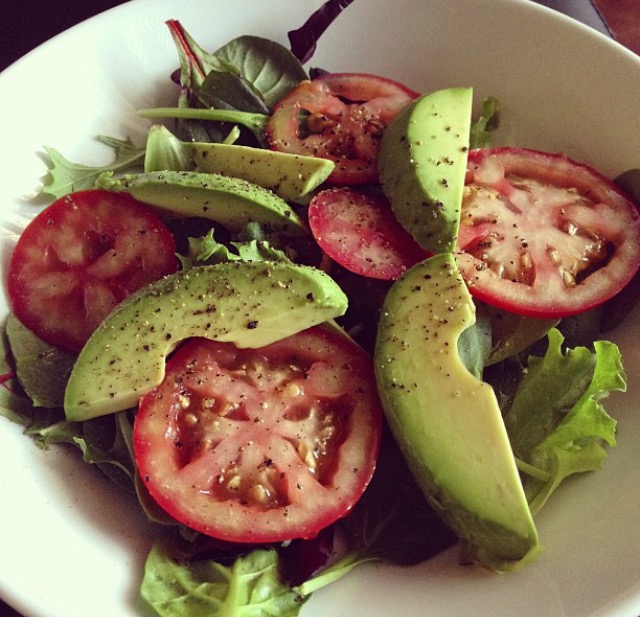
Heirloom Tomato SaladMexican Heirloom Tomato – Nothing beats fresh heirloom tomatoes… slice one and season with a pinch of sea salt. Add with sliced avocado to an herb salad mix. Shredded raw cheddar cheese is a perfect topping for additional flavor, and a few tortilla chip crumbles for crunch.  The dressing for this one is one of my favorites – cilantro-lime vinaigrette. Mix 2 Tbsp white wine vinegar, 1/4 cup lime juice, 1/4 cup chopped cilantro, 1 pressed garlic clove with 1/2 cup olive oil. Add dash of salt & pepper.

Happy Summer & Bon Appétit!

Do You Breakfast?

HoneymoonBreakfast is, by far, my favorite meal of the day.  If I didn’t have to rush out the door each morning for work, I’d take the time to prepare poached eggs, migas or cinnamon french toast with strawberries (paired with a coconut milk cappuccino or mimosa, of course!).  Getting to enjoy breakfast is one of my favorite parts of vacation and the weekends.

But reality is most of us just don’t have time for that. Most of you, I can imagine, skip breakfast altogether most mornings.  I’m sure you’ve heard it time and again, but breakfast really is the most important meal of the day.  It jump starts your metabolism, gives you energy, and prevents the hunger that puts you in a bad mood or causes you to overeat later in the day.  Plus, a healthy breakfast gives your body the best chance of absorbing those vitamins and minerals more easily at the start of the day, cutting down on your cravings later.

When my doctor told me last Fall that I needed to add 80 grams of protein into my diet each day, I knew that I would have to find a way to increase my intake at breakfast.  I thought I would share a few of my quick go-to favorites for those of you looking to mix up your routine:

Poached Eggs on Sprouted Wheat Toast with AvocadoPoached Eggs

If you have an egg poaching pan, this option is as fast and easy as boiling an egg.  While the eggs are cooking, I toast a piece of sprouted wheat bread (read why here), slather with organic butter or coconut oil and then top with sliced avocado.  It takes me about 7 minutes total to throw together this delicious, filling meal.

On a side note, I always make sure to buy free-range, organic, soy-free eggs because they are the most nutrient-dense.  I get this local brand at Whole Foods/Natural Grocers and love them; you truly can taste the freshness: Coyote Creek Farms.

Egg Bacon Muffins

I originally found this recipe on one of my favorite health blogs, Wellness Mama, and I love its versatility.  It is so incredibly easy to mix up a batch and throw in whatever extra vegetables are in your fridge.  Also, bacon!  I will make these on Sunday night for the week.  I usually eat a couple of these at a time – wrap them in foil and warm a few minutes in the toaster oven, then eat them in the car.  If you want to nix the bacon for whatever crazy reason, you can also just whip up some eggs, throw in some diced veggies and bake in muffin tins for mini frittatas.

“Bento Box”Bento Box

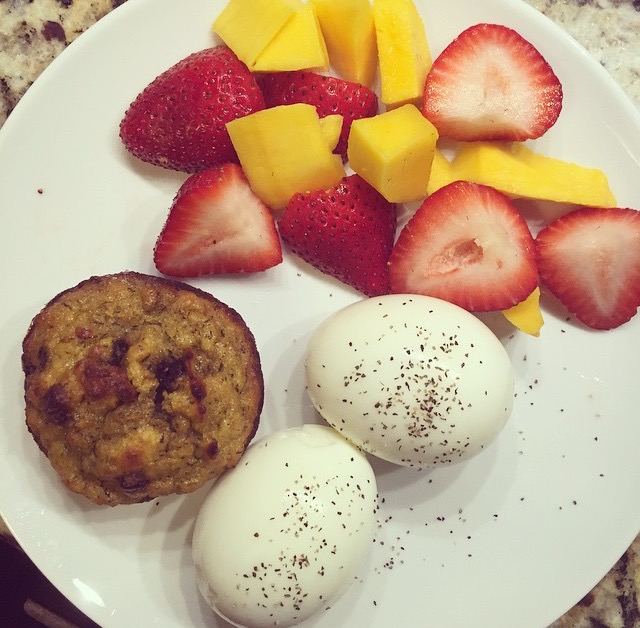
This is another one of those easy make-ahead options that you can put in a container to grab on your way out the door.  Simply boil a couple of eggs (can’t boil an egg? try this!), throw in a few berries for an antioxidant boost and then I add a muffin or two that I’ve baked on Sunday.  This gluten-free banana muffin is one of my favorite & totally healthy recipes – you can add in a couple tablespoons raw honey if you like it sweeter or some dark chocolate chips and nuts for some texture.

Greek Yogurt & Grain-Free Granola

Yogurt and GranolaGreek Yogurt is a yummy way to get some great protein in the AM with 15 g in 1 cup.  I personally love the Wallaby brand made with organic whole milk from pasture-raised cows and no artificial ingredients. Then, I top with some grain-free granola and fresh berries.  I recently found this Wildway Granola at Whole Foods and fell in love… it’s not cheap but it’s packed with fiber & protein (8g), is completely raw, has no added sweeteners. It is made entirely of fruit, nuts, and seeds, so is gluten-free, paleo and truly the healthiest pre-made version of granola you can buy.  P.S. I also love this as a late night protein snack to help me fall asleep.

GoMacro Bars

If you want an option with zero prep, try these tasty, wholesome breakfast bars.  My favorite is the Peanut Butter Chocolate Chip with 12 grams of protein.  I love this brand because they are organic, GMO-free, soy free (try finding another protein bar that is, especially with chocolate), free of refined sugar AND are reasonably priced compared to other options.  The whole mission of GoMacro is to provide a “macrobiotic” or minimally processed, found-in-nature product. You can buy them individually or by the case for a discount at Whole Foods or Natural Grocers.

Any other healthy breakfast ideas? Please share – I am always looking to mix it up!

I Heart Coconut Oil

Coconut Oil Miracle

Beginning in the 1960s, research began to emerge that some forms of saturated fat can increase blood cholesterol.  In general, saturated fat became feared as a major cause of heart disease, clogging our arteries and killing us slowly.  Coincidentally, at that time, the farming and production of soy products domestically was becoming a huge industry and the American Soybean Association was seeking to eliminate imported tropical oils from the market.  By the 1980s, the government and media jumped on the bandwagon against coconut oil and vegetable/canola oil became the “healthy” choice.  As a result, our products changed and we were no longer getting the nutritional benefits of coconut oil in our food. Since that time, our nation has actually seen an increase in heart disease, cancer, diabetes, and obesity.

How do you decide what to believe when it comes to your health?  This is the ultimate question I get when I tell people I write a wellness blog because there are so many contradictory opinions and “facts” out there.  Since I seem find myself always going against the grain on what’s generally accepted as healthy, I have to explain my rationale a lot.  While there’s much more that plays into my beliefs, it usually comes down to this: look at the facts and the research, but focus on the sources.  Personally, I am less likely to believe information coming from a medical journal published by a pharmaceutical company or a government recommendation based on profit to the economy.  Often, the source of the information really sheds some light on possible motives involved in the dissemination of that message.  For example, compare the likely credibility of a doctor who supports some drug and just happens to make lots of money from said support versus the doctor who is standing up against their institution and risking losing their job or research funding because of it.  While it may seem like a dramatic example, I find it all too common in my research.

Okay, back to the topic at hand: enter our current world of everything canola oil and a country dying of chronic illnesses. The Coconut Oil Miracle opened my eyes to all the health benefits the fruit has to offer – it’s pretty amazing and we’ve really been missing out.  What I loved about the book is that it uses research based on real cultures: “Coconuts (and coconut oil) have been used as a major source of food for thousands of years by millions of people in Asia, the Pacific Islands, Africa, and Central America.  Traditionally these people have had much better health than those in North America and Europe who don’t eat coconut.”  The book also explains the science behind why the fat in coconut oil is so beneficial to us.  The main reason it’s so beneficial is that it’s comprised of medium-chain and short-chain fatty acids, which our body breaks down for energy rather than storing as fat like the long-chain fatty acids in vegetable oil.

Let’s talk for a bit about free radicals. Free radicals cause cellular damage as they seek to steal electrons from other molecules, causing a chain reaction creating more free radicals stealing electrons.  They attack our cells, causing damage and mutations.  Ultimately, they cause degenerative diseases like cancer, heart disease, and diabetes, failing memory, reproductive problems, aging… the list goes on. We encounter free radicals throughout our environment and some occur naturally so they cannot be completely avoided, but many of the additives and toxins in our food promote their destruction.  It’s important to limit your exposure to free radicals and incorporate antioxidants into your diet as they’re the only way to stop them. Vegetable oils contain a high amount of free radicals because they are chemically unstable and oxidize so easily.  Coconut oil, on the other hand, contains none of these and also helps fight the ones you experience in your environment by giving you a boost of antioxidants, plus it’s safe and still beneficial after heated during cooking – a rarity among oils.

The book goes on to detail all the proven health benefits coconut has and the list will astound you:

  • “Coconut oil protects the heart and arteries from injury caused by bacteria, viruses and free radicals.  By removing the cause of arterial injury, coconut oil prevents further damage, allowing the arterial walls to heal, thus not only reducing the risk of heart disease but actually promoting healing.”
  • An New Caledonia island study revealed that islanders near ports eating modern foods “had an incidence of dental cavities of 26 percent, and those who lived inland and on a diet of native foods an incidence of 0.14 percent.”  These islanders with phenomenal dental health ate lots of coconut and “never brushed their teeth, never flossed, never used antibacterial mouthwash and never saw dentists.”
  • “Today people are suffering and dying from illnesses that science predicted 40 years ago would be wiped off the face of the earth…. Experts say our overuse of antibiotics is largely to blame: antibiotics encourage proliferation of drug-resistant bacteria.”  “Even the super germs are vulnerable to the lifesaving coconut derivatives. The unique properties of coconut oil make it, in essence, a natural antibacterial, antiviral, antifungal, and antiprotozoal food.” *emphasis added
  • “By far the best and richest natural sources of lauric acid are coconuts and coconut oil.”  Lauric acid kills lipid-coated microorganisms like HIV, measles, herpes, influenza, leukemia, hepatitis C, staph, and strep, just to name a few.
  • The medium-chain fatty acids (MCFAs) in coconut oil work for our immune system just like they do for newborns from a mother’s breast milk.  MCFAs kill bacteria that causes a multitude of STDs, staph, food poisoning, meningitis, ulcers and sinusitis.  They also defend against parasites that can cause food allergies and chronic fatigue.
  • The vegetable oils that you consume attack your thyroid and make you fat.  Replacing those oils with coconut oil, which adds MCFAs to the mix and increases your metabolism, can actually help you lose weight.
  • “Polynesian women are famed for their beautiful skin and hair, even though they are exposed to the hot blistering sun and chafing of the ocean breeze every day.” Free radicals in our food and environment cause advanced aging to occur, but the antioxidants in coconut oil work to combat that. Coconut oil also protects your skin from germs, acts as a healing agent and is an incredible moisturizer.  I use it as a lotion, as a hair conditioning treatment, and as my sunscreen – it “enables the body to adjust naturally to sun exposure, naturally increasing the body’s tolerable level over time.”
  • Coconut oil is considered a catch-all healing medicine in many countries, helping with digestive issues, nourishment to newborn babies, osteoporosis, chronic fatigue syndrome, cancer, diabetes and liver disease.

So how can you incorporate coconut oil into your diet and routine?  The book recommends 3 1/2 tablespoons daily… you can cook with it (replace any oil with it, same amount), put it in your coffee (if you love lattes, check out this amazing recipe), or use it on your skin.   You’ve got to put this book on your reading list… it’s such an easy read and there is so much more information and case studies that will really amaze you.

Will you give coconut oil a try?  Let me know what you think… I’m hoping you all become just as obsessed as I am!

Source: The Coconut Oil Miracle written by Bruce Fife, C.N., M.D.