Health Foodie

I'm a Foodie

I love to eat delicious food and I’m lucky to live in the great city of Austin, a place with many great options when it comes to healthy dining.  I feel like it’s pretty easy to stick to a healthy diet when I’m cooking and eating at home, but when it comes to going out with friends or my hubby for date night, I tend to splurge a little.  I thought I would share with you some tried-and-true places in Austin that make eating out guilt-free a little easier:

  • Uchiko – I am sure you’ve heard that this is best place in Austin to eat. Let me tell you: it really, really is.  Responsibly fished seafood is hard to find and this place has it, along with lots of fresh produce and flavor galore. Go for their social hour to make it more affordable, but it really is worth every dime.
  • Hopdoddy – Best burger you’ll ever have.. I am obsessed! While not everything here is organic, at least they have hormone & antibiotic-free meat as well as lots of local ingredients.  I also LOVE that they have flouride-free water.
  • Tacodeli – Incredible tacos for breakfast and lunch. They have a great commitment to using locally-sourced organic produce, meat and eggs. Also, the best queso ever (I won’t judge you for trying it)!
  • Trace – Perfect place for date night!  They use seasonal, locally-sourced organic ingredients in their ever-changing, seriously yummy menu that will give you a taste of Texas.
  • Hillside Farmacy – Cool, old-fashioned pharmacy decor paired with delicious food from local farms.  I almost always try one of their specials and have never been disappointed here.  Their homemade soda cocktails are some of my favs.
  • Urban: An American Grill – Not your typical hotel restaurant, this modern place has innovative farm-to-table options.
  • The Steeping Room – My favorite place for lunch!  Tons of healthy options, especially conscious of those with food allergies.  And their tea menu is out of this world!
  • Eastside Cafe – Fresh, organic produce fills the menu – you’re eating right out of the garden here.  And it’s totally affordable too.
  • Wink – Cozy, romantic restaurant + a cool wine bar.  Their menu changes daily to reflect the most seasonal ingredients.
  • Lick – Ice cream is my guilty pleasure, and I have found the best. Their “honest” ice cream is home-made with organic, local dairy and no preservatives, corn syrup or artificial flavors.  They have amazing, unique flavors to choose from, with many seasonal options.  Currently in love with: S’more Meringue.
  • 24 Diner – I love breakfast food and they have some of the best in Austin.  Plus, most of their food is farm-to-table.
  • Green Pastures – French-inspired cuisine made with local ingredients.  Old Victorian mansion is the perfect place for a girls lunch. Say hi to the peacocks roaming the lawn!
  • Carillon – Beautiful food near my favorite university.  Perfect date night before a walk around campus.
  • Promise Pizza – A great option for those football Saturdays, nights you need delivery, or just crave pizza. Their organic pizza is delicious, plus you can get gluten-free crust.
  • Beets Living Foods Café – Everything is made with raw, living foods and is surprisingly delicious. Be ready to get out of your comfort zone and try lots of new things!
  • Mother’s Cafe and Garden – I’m no vegan, but this vegetarian place is great place to get your veggies. Their flavorful veggie dishes didn’t make me miss meat.
  • Olive & June – Beautiful venue, interesting food and seriously refreshing signature cocktails.

Austin has an ever-growing abundance of great new places to try and it’s impossible to keep up.  Here are a few I’ve heard have fantastic healthy options that I’ve yet to try and really want to. Husband, take note:

Fellow Austin health foodies, what did I miss on my bucket list?  And more importantly, who wants to join me for dinner?

Update 2/21 – Part 2 of this list continued here!  Plus, if you want to get an idea of what’s near you, check out this Pinterest Map I created of all the places above and follow my board for more ideas to come!
The Truth About Exercise?

Tennis ShoesRecently I watched a program on PBS called The Truth About Exercise with Michael Mosley that addressed some surprising new research and challenged many of the things I had ever heard about working out.  Y’all, I hate exercising.  I will do whatever I can to avoid it, especially when life gets busy… or I’m tired, or stressed, or lazy, or just having too much fun to not have fun.  If you’re anything like me, I think you’ll find some hope in what this program had to say.

There is obviously a relationship between weight loss and exercise – we’ve all seen the inspiring stories about people who started crossfit or trained for a race and shed the pounds.  Then, we also hear that exercise is not really sustainable for losing weight, that it’s about what we eat and maintaining a healthy diet.  And, truly, eating right does work for everyone. But, there are other benefits of exercise to consider as well:

  • “Exercise gives you endorphins. Endorphins make you happy…” – Elle Woods.
  • Lowers blood pressure and risks of stoke & heart attack
  • Lowers your risk of diabetes. This program showed how 90 minutes of walking the night before a terrible-for-you breakfast reduced fat deposits from that meal by a third. The enzymes (lipo protien lipase) released during exercise stay in the system and make fat go to be burned by muscles rather than into our fat stores. This prevents damage to our blood vessels and also the deep fat in our organs (fat around our waist) that’s really dangerous.

Let’s be honest, though, for all that hard work, most of us are really looking to lose weight.  Unfortunately, it does not give many the fat burn they really want.  In fact, it has now been scientifically proven that people respond very differently to the same amount and type of exercise.  15% of the population see huge physical benefits from exercise, while 20% of the population see absolutely no change.  Those 20% are called non-responders and, unfortunately, it’s genetic.  Then there are the other 65% who are somewhere in the middle of that range.  Exercise is not one size fits all… exercising more may not help you, and that, combined with our busy lives, is certainly not motivating us to get to the gym.

Professor Jamie Timmons, University of Birmingham (UK), performed clinical studies of non-responders and set out to find a form of exercise that helps everyone and is sustainable enough to fit into our busy lives.  They used two main tests to measure the health benefits – 1. Insulin Sensitivity (Insulin removes sugar from the blood and controls fat – I discussed this in detail a few weeks back; sensitivity is a measure of how quickly it works) and 2. VO2 Max (how much oxygen your body is able to use, which is a huge indicator of the future health of your cardiovascular system).  Studies suggest that short spurts of highly intense exercise is what can improve these two: 20 seconds of the most intense exercise you can handle, followed by period of rest, repeated twice.  Do that three days a week.  This can be cycling as fast as you can on a stationary bike or sprinting down the street.

How can this possibly work?  That crazy intense form of exercise breaks down the glycogen stores in the muscle and that’s the key signal from the muscles to say “I need more glucose to burn, NOW!” to the blood.  Unlike walking or jogging, where you are only activating 20-30% of your muscles, this intense exercise is activating 70-80% of your muscles, which creates a much larger sink in glucose, causing your body to get more sugar out of the blood to burn.  In fact, they saw results in these two crucial areas in just 2 weeks.

After the show’s host, Michael Mosley, participated in 4 weeks of this protocol, they tested his insulin sensitivity and VO2 Max. He had an overall improvement of insulin sensitivity of 23%, which is remarkable, but in line with what the clinical studies are proving.  Michael also learned that his aerobic activity did not increase at all which proved (along with a genetic test) that he is a non-responder to exercise.

A couple other interesting things I learned from the program:

  • Most of us spend 12 hours a day sitting and not moving.  Being active increases your metabolic rate. Moving throughout the day is how we were designed, so that’s obviously best for our bodies.  Dr James Levine, Mayo Clinic, an obesity expert, says that the best way to burn fat is to increase your NEAT – Non-Exercise Activity Thermogenesis.  No need to sweat, but make a more conscious effort to constantly move.  Our bodies idle when we sit for an hour, gunk builds up: blood sugar and fat elevate. In order to keep the fuels moving through your system, you need to be moving every hour, not just exercise a couple times per week.
  • We may feel like our muscles are what get tired and that’s why exercise exhausts us, but, actually, it may be our brain.  Michael Mosley did a test in a low oxygen chamber and he got tired very fast as soon as his brain realized that he wasn’t getting enough oxygen.  This measured how hard he thinks he can push his muscles. But when probes were applied to his head, putting pressure on the part of the brain controlling his legs, it allowed him to push himself to keep exercising. Our subconscious brain is protecting itself – it triggers a shutdown before you are actually in “danger.” But, your brain can learn that this activity is not threatening which is why it begins to feel easier after training.

If you want to learn more, I highly recommend watching it for yourself here.

Do you think these experts discovered the truth about exercise?  Could you commit to this 3-minute-a-week exercise routine?  Who wants to try it with me to see if it works?

Let’s Talk Teeth

Shark Teeth

In honor of Shark Week, let’s talk teeth!

Last week, I visited the dentist for my 6-month cleaning appointment and received a glowing report: no cavities, no gum disease, not even a “you could be flossing or brushing better.”  When is the last time you got a report like that?  Well, for me, this was phenomenal news compared to my last dental visit…

See, earlier this year, I went in for my normal cleaning and the dentist gave me some grim news.  Apparently I had a serious bacterial infection that was causing gum disease in my mouth.  I was urged to spend $500 on a test that would pinpoint the exact bacteria attacking my mouth, which would direct them to prescribe the appropriate antibiotics, and maybe even steroids, to fight the bacteria.  I was also told to implement a new routine into my dental care: schedule cleanings every 3 months and purchase a high-end water pick as well as a pricey prescription dental wash (which I was appalled to find contained sucralose!).  To top it all off, the dentist mentioned that if this gum disease continued to ravage my mouth, it would likely cause heart disease and infertility problems.  Way to put the fear into a patient!

Okay, so I am admittedly cynical when it comes to anyone in the health profession.  Let’s be honest, this is their job… it’s how they support their families, and more problems with a patient certainly mean more money for them.  This was certainly not the first time in my life to receive a terrible diagnosis from a medical professional, and I knew from experience that I needed to do a little research of my own before agreeing to any treatment.

I take great care in what I put in my body, whether it’s food and drink or the hygiene and beauty products that my skin absorbs.  A few years ago, I learned about the dangers of fluoride and have since been filtering it out of my water at home as well as avoiding it in dental products.  Fluoride is used to prevent cavities because it kills the bacteria in our mouth, but unfortunately, we are getting far too much of it and it’s causing lots of health problems in the general population.  Just a few examples include cell death, brain damage, dementia, bone issues, lowered immune function and thyroid problems.  (Read more here and here.)  I take a daily iodine supplement to counteract the fluoride that I do consume through water outside my home and bathing since Austin’s water contains it.  More and more people are beginning to hear about the dangers of the fluoride chemical being added to our water supply, and some places, like Portland and Israel, have even voted to prevent it.  I have personally seen improvement in my hormone issues and memory since removing it.  All that to say, I needed a dental care solution without toxic fluoride or other harmful chemicals, which meant the dentist’s solutions were not going to happen.

Having found natural healing for so many other health issues in my life, I began to seek out some trusted sources that have helped in the past.  Thanks to a recommendation by my favorite Dr. Cate, I found a product called OraWellness. I purchased the OraWellness HealThy Mouth Blend to give it a try.   It is a blend of organic essential oils with bacteria-fighting properties to fight against gum disease and the bacteria that causes cavities. Basically, you use a few drops of the blend on your toothbrush instead of toothpaste.   It was hard to get used to not using toothpaste, but within a week I was sold. It tastes great and the small bottle travels easy.  I also love that you can use it on your floss or as a mouthwash for a deeper clean.   My mouth has never felt so fresh.  Plus, since you are just using a few drops at a time, a bottle usually lasts me 2-3 months, which is totally affordable. Also, they have these great toothbrushes with less bristles that feel so much better on my sensitive gums (thank you, seasonal allergies).  If you want to learn more about why the blend works, you can visit their website directly. Their blog also has some great insight into other dental care topics as well as how important a healthy mouth is to overall wellness.

Now, six months later, after using the product twice a day, I am free of gum disease, bacterial infection, cavities and have clean, fresh breath. Plus, I swear my teeth are whiter!  The dentist was shocked by the transformation of my mouth, and hopefully slightly convinced that the natural way can indeed heal.

Had you heard about the dangers of fluoride?  Would you ever try something new and natural to clean your teeth and gums?

Soy it ain’t so…

No more soy!

Thanks to the marketing efforts of the soy industry in the U.S. (we are the top producer of soy, contributing around 35% of the world supply), we’ve been deceived into thinking that soy is a phenomenal health food. It’s supposed to be heart-healthy and keep you young. Vegetarians rely on it as a protein source. It’s a widely available alternative for those with lactose intolerance. And the Japanese, whose diet is considered one of the healthiest in the world, have eaten it for years. Unfortunately, the truth is that it’s cheap, easy to process, and therefore has great margins for making money, hence the pervasive marketing. Even worse, it’s toxic to our bodies when not prepared or grown appropriately. Bad news is that the toxic kind is how it’s currently produced and consumed by all of us today.

Soybeans contain two chemicals, goitrogens and phytoestrogens, that affect your thyroid and sex hormones. Traditionally, the Japanese would soak and ferment the soybeans before using them, which neutralizes these harmful chemicals and creates tasty and healthful miso, tofu, etc. But now, in commercially made soy products (even in many of those organically grown), the fermentation process is skipped because it’s cheaper & quicker to do so; instead it is hydrolyzed, a process that does not remove the toxins. So the soy sauce, soy milk, infant formulas, soy protein bars, tofu and most processed products you buy in stores and eat at restaurants are passing those chemicals straight to your body. These chemicals cause thyroid (regulates growth, metabolism and energy levels) issues, like hyper/hypothyroidism and thyroid & pancreatic cancer, as well as reproductive organ problems for both men and women. Soy is also one of the most common allergens, especially among infants and toddlers.

In addition to the fact that already-present chemicals are not removed, the toxic solvent hexane (a chemical by-product of gasoline refining) is used to process soy proteins. Hexane can cause cancer, birth defects, reproductive issues, and adverse effects on the environment.

Even worse, 90% of soybeans are genetically modified, a serious health issue I discussed at length here. The GMO quality of these beans only adds to the health effects, now being linked to sterility and infant mortality.

Seeing a trend here? I don’t know about you, but when I learned about all this, I was immediately motivated to remove soy from my diet. Personally, I saw amazing changes in some hormonal issues I was suffering from within just a few weeks (starting with getting rid of my daily soy-protein bars at breakfast). Here’s a few suggestions to get you started:

  • When shopping, go for fresh foods instead of processed items. If you do buy packaged (even organic), look at the ingredients label and avoid these substances: soy, soy protein (isolate/hydrolyzed), soy lecithin, hydrolyzed plant/vegetable protein, monoglycerides, MSG, and soybean oil
  • If you are lactose-intolerant or vegetarian, go for cashew, almond or, my favorite, coconut milk. I find that unsweetened, full fat coconut milk tastes the most similar and works in recipes as an easy substitute – plus it makes delicious and healthy whipped cream!
  • Start your babies off right – most infant formulas contain GM soy. Breast-feeding is best, but if you must use formula, you will have to make your own, find a local goat farm for milk, or participate in a milk sharing program. Unfortunately, there are no soy-free options available for sale in the United States, but you can import from Europe (Holle brand in Germany).
  • Attention meat eaters: many fast food restaurants put soy flour and soy protein in their meat and buns, among other things…
  • Lastly, you can still enjoy those tasty Asian dishes with traditionally fermented soy sauce instead. I have found it at every grocery store I’ve visited and I actually like the taste better. Here’s one brand to try.  Or, you can use coconut aminos, which has a very similar taste and is completely soy-free.
I’d love to know… Is this the first you’ve heard about the dangers of soy? Will you try removing it from your diet?

The Time I Did A Juice Fast

fat-sick-and-nearly-dead

If you’ve ever seen Fat, Sick, and Nearly Dead, you’ve probably wondered about the benefits that juicing and a raw diet could provide for you.  Joe Cross was overweight and experiencing health issues that doctors could not find answers to (but had no problem prescribing him lots of pills for); finally, he met a natural doctor that told him that eating well was the only way to heal himself of his autoimmune skin disease.  So he decided to go on a 60 day organic juice-only fast, followed by months of only fruits, veggies, nuts and beans. He loses an incredible amount of weight and experiences an amazing health transformation. If you haven’t seen it, I highly recommend watching it on Netflix – it’s very inspiring.

Fresh juice is nothing like the high fructose corn syrup sweetened and artificially flavored and dyed stuff you find in the grocery aisle.  When you juice from real fruits and veggies, you are getting tons of  real nutrients.  You can pack pounds of these healthful, fresh items into just one juice. Plus, since you’re juicing out the fiber, your body is able to quickly absorb all those vitamins and nutrients rather than spending energy to digest them. If you believe in eating the hunter-gatherer way, then fasting is especially important as, naturally, there were times when food could be hard to come by. Our bodies are designed to need a break every once in a while.  And raw, fresh foods are part of the Four Pillars of World Cuisine.  The raw fruits and veggies in juice provide our bodies with potent antioxidants essential to combating harmful free-radicals (the molecules that cause every kind of disease, especially cancer).

Bonus: The major ingredients in my juices were 4 of the 5 best alkaline foods – lemons, cayenne pepper, leafy greens and apples.  Why does that matter?  Basically, our bodies are designed to keep a neutral pH level, but with all of the processed foods we eat, we often end up being highly acidic.  Being acidic can majorly affect your health by diminishing your immune system, causing fatigue, pain and even cancer.  The more alkaline and less acidic foods (the list may surprise you) you can eat to balance out your system, the better!

So, I had watched documentaries, read articles about and heard of friends doing juice fasts/cleanses and wanted to try it for myself. Although it was recommended to “pre-cleanse” by weaning off meat, dairy, sugar, wheat, etc., I didn’t.  Let’s be honest, most of us try a cleanse because we’ve been eating junk.. I did the cleanse because I wanted to break my taste for those things and get back on track. I did eat a little healthier and did no alcohol or caffeine as well as only eating fish and veggies for the 48 hours before so it wouldn’t be too bad of a shock.

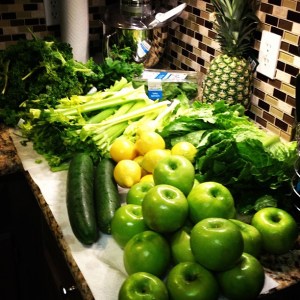
Fruits and Veggies Pre-JuiceI had looked into buying all the juice for my cleanse from a couple of local companies like JuiceLand and Skinny Limits, but when prices were coming up at $175-200 for an organic cleanse, I looked into the DIY option. I found some recipes online here and here that imitated the well-known BluePrint cleanse, borrowed a Jack LaLanne Pro juicer from a friend and then went shopping. I only spent $68.61 on organic fruits and veggies.  So worth it.  Now, the juicing took about 3 hours total, but considering I usually spend about an hour and a half each day preparing breakfast, lunch and dinner, that’s really not any different.  It was super nice to come home from work and have my “meal” already made and let my husband fend for himself.   I started with all these fresh vibrant fruits and veggies, which was more produce than I usually buy in a whole week.
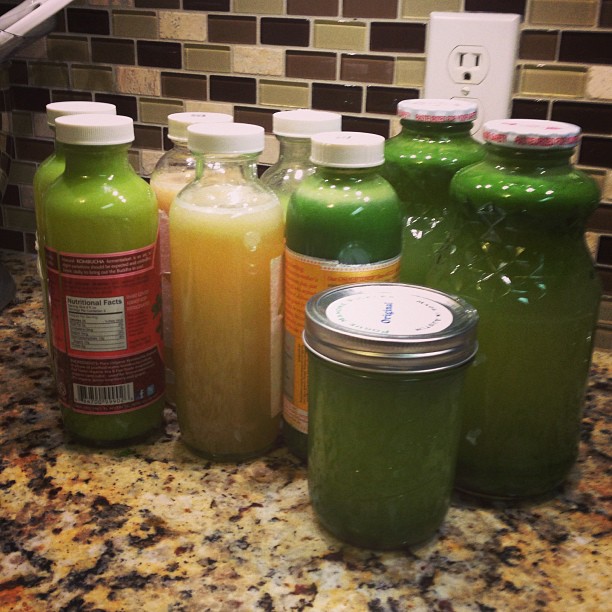
At the end, I had a little over 2 days worth of juice:

  1. Breakfast: Green Juice – Kale, Spinach, Romaine, Parsley, Apple, Cucumber, Lemon and Celery
  2. Morning Snack: Pineapple-Apple-Mint Juice
  3. Lunch: Green Juice
  4. Afternoon Snack: Agave-sweetened Lemonade with Cayenne Pepper
  5. Dinner: Green Juice
  6. Evening Snack: Cashew-Vanilla-Cinnamon Milk (which is blended, not juiced)

Juice

Biggest surprise?  How much I liked the juices. The green juice was delicious… a little celery-y, but super yummy. The cashew milk that everyone seems to love was the most disgusting thing ever. I only had it the first night and barely kept it down. I had more green juice the second night.

Biggest regret? Not starting an awesome compost pile with all the fruit and veggie pulp that the juicer collected.  Guess I’ll have to do it again!

Was it awful? Overall, I was really hungry the whole time, which is normal, but tough. Watching tv was hard and commercials made me crave donuts and pizza. They say that since your body is being detoxed, you could feel terrible… I really didn’t. In fact, I had more energy than ever. During the fast, I was kind of wondering if it was worth it and it wasn’t until afterwards that I realized it was.  I totally lost my desire for junk food and coffee and alcohol, and felt sick whenever I had those things, which definitely helped my self-control.  I also lost 4 pounds which I have easily kept off since.

Ultimately, I would recommend the experience to anyone, especially those suffering from sickness or trying to break bad food habits. I will absolutely be purchasing a juicer and making juice part of my normal routine so that I get more nutrients into my diet in a delicious way.  But, if I ever do a cleanse again, I’ll want a buddy… it was hard to do it alone!

So, what do you think? Would you ever try a juice cleanse?