A Health Challenge: My Goals

Auld Lang SyneWe are almost halfway through January and I wanted to check in… how are you doing with your New Year’s resolutions?   I’ll be honest, I’ve failed already.  But, I’m not giving up quite yet!  

I recently organized a health challenge for my office and have also decided to participate.  The challenge runs 12 weeks and started yesterday.  The competition is based off of body fat percentage loss since that is a good indicator of both fitness and health and more accurate than BMI.  Plus, you can see your percentage loss, weight loss and inches loss at the end, which is so encouraging.  Y’all, my current body fat percentage puts me in the “overweight” range… I have got to get back in that healthy range! I’ve known for awhile what I should be eating and doing to get my body healthy, I just haven’t had the self control to do it. As I sat down last night to think through my goals and make a plan, I knew that many of you also have some health resolutions this year and might want to see what I’m doing.  If you haven’t made a resolution yet – it’s not too late!  Here are the five things I am focusing on for this challenge, why they are important and some simple action steps to follow if you are interested in adapting them yourself:

  1. Increase Nutrients – With all the packaged and processed foods in our restaurants and grocery stores, we are no longer getting the nutrients our bodies are starved for.  We have essentially become malnourished as a culture.  The blog 100 Days of Real Food has some great meal plans and recipes to avoid processed food.  I will be focusing on eating real food with real health value to my body.  I will aim for 5+ servings of vegetables per day and a high protein, high fat diet to keep me full and give my body energy instead of relying on cheap carbs to do so.  Basically, I’ll just be eating lots of freshorganic produce and protein.
  2. Eat Clean – It is important to eliminate the toxins in our environment and foods that are causing harm to our bodies.  In order for the nutrients we eat to work effectively to help our body, we need to make sure we are not poisoning it at the same time.  I always look for these on food labels when grocery shopping or on a restaurant menu:
    Hormone-Free
    Antibiotic-Free
    Preservative-Free
    Pesticide-Free (Produce)
    Cage-Free (Eggs)
    Free-Range (Chicken)
    Grass-Fed (Beef)
    Wild-Caught (Fish)
    Non-GMO
    Nitrate-Free
  3. Eliminate Inflammatory Foods – While losing weight/inches/fat would be great, my main goal is health.  I want to get my hormones balanced, be pain-free and increase my immune function.  My adrenal levels are currently way high, which is inhibiting all of those things and causing me to gain weight.  Eek! The only way to fix it is to change my diet: I will be avoiding grains & cheap carbs, soy (as always!), sugar (except for a couple of special occasions & some dark chocolate here and there) and vegetable oil (I use coconut oil instead… and no, it doesn’t taste like coconut).
  4. Drink More Water – A couple of months ago, I read the book Your Body’s Many Cries for Water and learned so much about how dehydrated I am (I plan to write a review about the book soon!).  Drinking lots of water has tons of benefits, including losing weight & detoxifying the body.  Per the book’s recommendation, my goal will be to drink at least 64 oz of water per day, plus an extra 16 oz for any coffee or tea I drink since those beverages work to dehydrate us.  Also, less alcohol… red wine is healthy, right?
  5. Get Moving – I’ve said it before and I’ll say it again: I hate exercising.  I can commit to eating well all day, but commitments to exercise always fail.  Recently, I watched an interesting documentary about exercise and I really want to put the routine into practice.  It will only take 3 minutes a week… surely I can.  I’m going skiing soon and my trip to Europe this Spring will entail lots of walking, so I need to be in shape. I woke up this morning and worked out for the first time in years, so I’m off to a great start. Please, ask me next time you see me and hold me accountable!

Writing those out makes it seem a little less daunting than it did yesterday.  Instead of focusing on what I can’t have, I’m going to focus on all the yummy foods that I can eat…. here’s to bacon, avocados, raw cheese, BBQ, sushi, colorful salads, nuts, fresh juice, sweet potato fries, fried okra, dark chocolate, and (in case you forgot) bacon.  Cheers!  *Water glasses clink*

Who else wants to join me?  What are your goals?

One Year Down!

New Years 2014At the beginning of 2013 I made two resolutions: to become healthy and to write this blog as a way to keep myself motivated & educated.  As I have been reflecting on this past year the last two days, I feel so blessed that I’ve been able to meet and exceed my goals.

A year ago, I was starting to learn more about nutrition and natural healing and seeing some results, but I wanted more.  I wanted freedom from my chronic pain and illness.  I knew that it would take a lot of work… sorting through all the confusing, contradictory and controversial information on health out there to decide what I should follow and what would work for me, as well as consistently following the new diets and routines that I needed to integrate into my life.  I have plenty of room to improve on my health habits this year, but I certainly did better than ever in 2013.  While it’s easy to let vanity take over and feel bummed about the weight I never lost, I must focus on the true healing I’ve experienced.  I can’t remember a time where I got sick as little as I did this past year. And I went from being in near constant back pain to only every once in awhile now… y’all, it is life changing.  I enjoy life so much more now that I don’t have the cloud of pain hanging over me. I am so thankful to feel great almost every day when I wake up.  I pray that you’ve experienced healing too, this year.  If you have, I’d love to hear about it, and even share it here!

As for this blog, I could have never imagined all the success it’s had this year (even with my lack of consistency!).  I felt compelled to start it because of all that I was learning… I wanted my friends and family to be able to share in the healing that I was experiencing.  Honestly, I never imagined that this blog would reach as many people as it has.  I simply wanted an avenue to share with people I knew, and if only 20 people ever read it, I would have been thrilled.  But I’ve gotten visitors from all over the world!  In 2013, I had nearly 6,000 unique visitors to this site and I simply cannot believe it!  I’ve received great feedback from readers that my blog has helped them find reliable sources for health recommendations, that it’s opened their eyes to information they hadn’t heard before, or that it’s been nice to have a summary of topics that they wouldn’t have the time or energy to research otherwise.  I love this stuff, so I am happy to help 🙂 To close out the year, I thought I would share my most popular posts of 2013 in case you missed anything!

Most Read Post – Kombucha Home-Brew during Fabulous Fermentation Week

Most Pinned Pinterest Image – Whipped Coconut Milk

Most Popular Recipe – Parmesan Pesto Chicken & Herb Stuffed Brussel Sprouts

Most Controversial – Why I’m Not a Vegan

Most Reader-Shared – Soy it Ain’t So and Why We Get Fat

I have been reading lots of interesting books lately and I’m excited to share lots more in 2014, so stay tuned for more posts soon.  Be sure to hit the “Follow” button at the top right corner of my site to get an email whenever I publish a new blog if you don’t want to miss anything!  And leave a comment to let me know what you would like to see more of on this blog… documentary reviews? book summaries? health controversies? recipes?  I’d love your feedback!

Wishing you a healthy & hopeful 2014!

Let’s Talk Teeth

Shark Teeth

In honor of Shark Week, let’s talk teeth!

Last week, I visited the dentist for my 6-month cleaning appointment and received a glowing report: no cavities, no gum disease, not even a “you could be flossing or brushing better.”  When is the last time you got a report like that?  Well, for me, this was phenomenal news compared to my last dental visit…

See, earlier this year, I went in for my normal cleaning and the dentist gave me some grim news.  Apparently I had a serious bacterial infection that was causing gum disease in my mouth.  I was urged to spend $500 on a test that would pinpoint the exact bacteria attacking my mouth, which would direct them to prescribe the appropriate antibiotics, and maybe even steroids, to fight the bacteria.  I was also told to implement a new routine into my dental care: schedule cleanings every 3 months and purchase a high-end water pick as well as a pricey prescription dental wash (which I was appalled to find contained sucralose!).  To top it all off, the dentist mentioned that if this gum disease continued to ravage my mouth, it would likely cause heart disease and infertility problems.  Way to put the fear into a patient!

Okay, so I am admittedly cynical when it comes to anyone in the health profession.  Let’s be honest, this is their job… it’s how they support their families, and more problems with a patient certainly mean more money for them.  This was certainly not the first time in my life to receive a terrible diagnosis from a medical professional, and I knew from experience that I needed to do a little research of my own before agreeing to any treatment.

I take great care in what I put in my body, whether it’s food and drink or the hygiene and beauty products that my skin absorbs.  A few years ago, I learned about the dangers of fluoride and have since been filtering it out of my water at home as well as avoiding it in dental products.  Fluoride is used to prevent cavities because it kills the bacteria in our mouth, but unfortunately, we are getting far too much of it and it’s causing lots of health problems in the general population.  Just a few examples include cell death, brain damage, dementia, bone issues, lowered immune function and thyroid problems.  (Read more here and here.)  I take a daily iodine supplement to counteract the fluoride that I do consume through water outside my home and bathing since Austin’s water contains it.  More and more people are beginning to hear about the dangers of the fluoride chemical being added to our water supply, and some places, like Portland and Israel, have even voted to prevent it.  I have personally seen improvement in my hormone issues and memory since removing it.  All that to say, I needed a dental care solution without toxic fluoride or other harmful chemicals, which meant the dentist’s solutions were not going to happen.

Having found natural healing for so many other health issues in my life, I began to seek out some trusted sources that have helped in the past.  Thanks to a recommendation by my favorite Dr. Cate, I found a product called OraWellness. I purchased the OraWellness HealThy Mouth Blend to give it a try.   It is a blend of organic essential oils with bacteria-fighting properties to fight against gum disease and the bacteria that causes cavities. Basically, you use a few drops of the blend on your toothbrush instead of toothpaste.   It was hard to get used to not using toothpaste, but within a week I was sold. It tastes great and the small bottle travels easy.  I also love that you can use it on your floss or as a mouthwash for a deeper clean.   My mouth has never felt so fresh.  Plus, since you are just using a few drops at a time, a bottle usually lasts me 2-3 months, which is totally affordable. Also, they have these great toothbrushes with less bristles that feel so much better on my sensitive gums (thank you, seasonal allergies).  If you want to learn more about why the blend works, you can visit their website directly. Their blog also has some great insight into other dental care topics as well as how important a healthy mouth is to overall wellness.

Now, six months later, after using the product twice a day, I am free of gum disease, bacterial infection, cavities and have clean, fresh breath. Plus, I swear my teeth are whiter!  The dentist was shocked by the transformation of my mouth, and hopefully slightly convinced that the natural way can indeed heal.

Had you heard about the dangers of fluoride?  Would you ever try something new and natural to clean your teeth and gums?

The Time I Did A Juice Fast

fat-sick-and-nearly-dead

If you’ve ever seen Fat, Sick, and Nearly Dead, you’ve probably wondered about the benefits that juicing and a raw diet could provide for you.  Joe Cross was overweight and experiencing health issues that doctors could not find answers to (but had no problem prescribing him lots of pills for); finally, he met a natural doctor that told him that eating well was the only way to heal himself of his autoimmune skin disease.  So he decided to go on a 60 day organic juice-only fast, followed by months of only fruits, veggies, nuts and beans. He loses an incredible amount of weight and experiences an amazing health transformation. If you haven’t seen it, I highly recommend watching it on Netflix – it’s very inspiring.

Fresh juice is nothing like the high fructose corn syrup sweetened and artificially flavored and dyed stuff you find in the grocery aisle.  When you juice from real fruits and veggies, you are getting tons of  real nutrients.  You can pack pounds of these healthful, fresh items into just one juice. Plus, since you’re juicing out the fiber, your body is able to quickly absorb all those vitamins and nutrients rather than spending energy to digest them. If you believe in eating the hunter-gatherer way, then fasting is especially important as, naturally, there were times when food could be hard to come by. Our bodies are designed to need a break every once in a while.  And raw, fresh foods are part of the Four Pillars of World Cuisine.  The raw fruits and veggies in juice provide our bodies with potent antioxidants essential to combating harmful free-radicals (the molecules that cause every kind of disease, especially cancer).

Bonus: The major ingredients in my juices were 4 of the 5 best alkaline foods – lemons, cayenne pepper, leafy greens and apples.  Why does that matter?  Basically, our bodies are designed to keep a neutral pH level, but with all of the processed foods we eat, we often end up being highly acidic.  Being acidic can majorly affect your health by diminishing your immune system, causing fatigue, pain and even cancer.  The more alkaline and less acidic foods (the list may surprise you) you can eat to balance out your system, the better!

So, I had watched documentaries, read articles about and heard of friends doing juice fasts/cleanses and wanted to try it for myself. Although it was recommended to “pre-cleanse” by weaning off meat, dairy, sugar, wheat, etc., I didn’t.  Let’s be honest, most of us try a cleanse because we’ve been eating junk.. I did the cleanse because I wanted to break my taste for those things and get back on track. I did eat a little healthier and did no alcohol or caffeine as well as only eating fish and veggies for the 48 hours before so it wouldn’t be too bad of a shock.

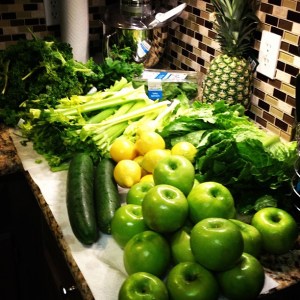
Fruits and Veggies Pre-JuiceI had looked into buying all the juice for my cleanse from a couple of local companies like JuiceLand and Skinny Limits, but when prices were coming up at $175-200 for an organic cleanse, I looked into the DIY option. I found some recipes online here and here that imitated the well-known BluePrint cleanse, borrowed a Jack LaLanne Pro juicer from a friend and then went shopping. I only spent $68.61 on organic fruits and veggies.  So worth it.  Now, the juicing took about 3 hours total, but considering I usually spend about an hour and a half each day preparing breakfast, lunch and dinner, that’s really not any different.  It was super nice to come home from work and have my “meal” already made and let my husband fend for himself.   I started with all these fresh vibrant fruits and veggies, which was more produce than I usually buy in a whole week.
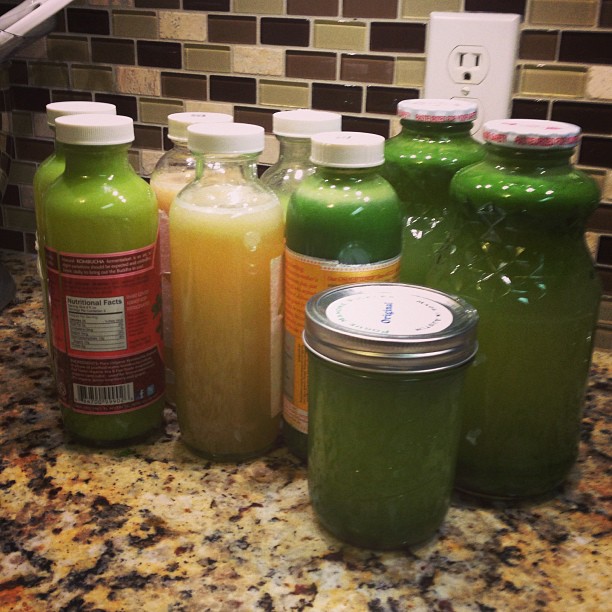
At the end, I had a little over 2 days worth of juice:

  1. Breakfast: Green Juice – Kale, Spinach, Romaine, Parsley, Apple, Cucumber, Lemon and Celery
  2. Morning Snack: Pineapple-Apple-Mint Juice
  3. Lunch: Green Juice
  4. Afternoon Snack: Agave-sweetened Lemonade with Cayenne Pepper
  5. Dinner: Green Juice
  6. Evening Snack: Cashew-Vanilla-Cinnamon Milk (which is blended, not juiced)

Juice

Biggest surprise?  How much I liked the juices. The green juice was delicious… a little celery-y, but super yummy. The cashew milk that everyone seems to love was the most disgusting thing ever. I only had it the first night and barely kept it down. I had more green juice the second night.

Biggest regret? Not starting an awesome compost pile with all the fruit and veggie pulp that the juicer collected.  Guess I’ll have to do it again!

Was it awful? Overall, I was really hungry the whole time, which is normal, but tough. Watching tv was hard and commercials made me crave donuts and pizza. They say that since your body is being detoxed, you could feel terrible… I really didn’t. In fact, I had more energy than ever. During the fast, I was kind of wondering if it was worth it and it wasn’t until afterwards that I realized it was.  I totally lost my desire for junk food and coffee and alcohol, and felt sick whenever I had those things, which definitely helped my self-control.  I also lost 4 pounds which I have easily kept off since.

Ultimately, I would recommend the experience to anyone, especially those suffering from sickness or trying to break bad food habits. I will absolutely be purchasing a juicer and making juice part of my normal routine so that I get more nutrients into my diet in a delicious way.  But, if I ever do a cleanse again, I’ll want a buddy… it was hard to do it alone!

So, what do you think? Would you ever try a juice cleanse?

Why We Get Fat…

“We get fat, our physicians tell us, because we eat too much and/or move too little, and so the cure is to do the opposite.” – Michael Pollan, In Defense of Food

When my husband and I are planning a date night out to a really great restaurant and want to eat as much delicious food as possible, we often eat a light lunch or do something active to make ourselves hungrier for the big meal. But wait, that’s also what I’m told to do to lose weight…. Something’s wrong with this reasoning.

In his book, Why We Get Fat: And What to Do About It, Gary Taubes tackles this cultural mindset of “calories in, calories out,” turning it on it’s head and calling into question a principle we’ve always held to be true. It’s a fascinating read, with lots of really compelling cultural case studies and the scientific details in layman’s terms that help you to understand his argument.   I have a bad habit of reading the Appendix of a book first and will admit that I was disappointed with some of the diet recommendations he makes – in particular, okaying alternative sweeteners like Splenda and Nutrasweet and diet soda; but, I had a long plane flight ahead of me and nothing else to read so I kept on.  I’m glad I endured because there are definitely some great nuggets of information I got from this book:
 Obesity has become an epidemic.  1 in every 3 Americans are considered obese compared to only 1 in 9 fifty years ago. I’ll admit that I used to think that most people get fat by simply being lazy and/or eating too much junk food.  But, a case study of many areas of poverty shows that there are many who are malnourished (less calories in), work manual labor (more calories out), and who are still obese or overweight.  And in research studies, hormone-manipulated rats proved that they immediately began to overeat, become sedentary and quickly grew obese; even when completely deprived of food, forced to diet or forced to exercise, the rats retained their fat while their organs deteriorated.  There must be some other determining factor than being slothful and gluttonous…. it seems more to do with genes and hormones than simply overeating.  The answer lies within the fundamental definition of obesity- “a disorder of excess fat accumulation.”

Taubes relates fat tissue to a wallet: “you’re always putting fat into it and always taking fat out.”  But only certain forms of fat can go in and out, while others go in and stay. When fatty acids enter a fat cell, they join up with a glycerol molecule and two other fatty acids to become a triglyceride. Triglycerides are too big to go back out of the cell membrane, so they stay captive until they can be disassembled.  The hormone that works to create triglycerides is insulin.  Insulin works through the LPL enzyme and the HSL enzyme.  The LPL enzyme sends fatty acids into the cells for energy. When we exercise, LPLs trigger the release of fat from fat tissue and send those into muscle cells to burn off.  (As soon as we stop, though, LPLs work to help fat cells regain that fatty fuel, which is why Taubes claims exercise doesn’t make us lose fat, just gains us muscle.) The rest of the time, insulin triggers LPLs to send fatty acids into fat cells and tells muscle cells to burn blood sugar rather than fatty acids, so insulin basically keeps these fatty acids in your fat cells.  Insulin also suppresses the HSL enzyme, which is the enzyme that breaks down the triglycerides into fatty acids to move out of the fat cells.  And when our fat cells get full, insulin creates new ones… working constantly to make us fatter… it’s no wonder that so many diabetics that start insulin therapy gain so much weight.  Further, every other hormone in our body works to release fat from our fat tissues so that it can provide fuel for what it needs to do, but “insulin trumps the effects of other hormones.”  And as we get fatter, our demand for more fuel increases, which causes our appetite (especially for carbs) to increase. So, to lose fat, we must lower our insulin levels.  The way to do that is to diminish the cause for insulin secretion – carbohydrates.

Okay, but I eat healthy and I still struggle to lose weight, while I watch others eat fast food daily and stay super slim… frustrating, isn’t it? One reason is that “some people will secrete more insulin than others, and those who do are likely to put on more fat and have less energy.”  The other reason is that many of us have become insulin resistant. Eventually, your cells stop wanting all the glucose you’re putting in your body, and they start making insulin’s job harder to get it out of the bloodstream, which results in you secreting even more of it.  Everyone’s tissues react differently: if your muscle tissue is really sensitive to insulin, then you’ll use up more glucose in those cells, making you naturally lean, but if your fat cells are more sensitive, then glucose will go there instead and you’ll become overweight. And as we age, our muscles naturally become more resistant to insulin, which explains why we tend to get fatter as we get older.  Most importantly, this doesn’t just affect us, but our children too.. “the higher the level of a mother’s blood sugar, the more glucose her child gets in her womb” and therefore will be born with more fat and predisposition to be insulin resistant.

At this point in the book, he had my attention… is this resounding with you as well?  Tune in tomorrow for And What To Do About It.