Tips for Staying Fit During Thanksgiving

With a holiday so centered around a tempting buffet of food, lazy days watching football and pies galore, it can be hard to not feeling like the stuffed turkey after Thanksgiving. Here are a few tips on how to stay fit and healthy during your Thanksgiving holiday:

Eat Breakfast: We tend to save up our appetite for a big meal, but you’ll end up overeating if you do.

Chew Slowly: Focus on your loved ones and enjoy the dinner table conversation. Give your body time to process how much you’re eating so you don’t eat too much.

Drink Water: Our bodies often misinterpret being thirsty as being hungry; staying hydrated will help you eat appropriately-sized portions.  And, remember, that all those liquid calories in alcohol can really sneak up on you too.

Exercise: Take your family to the Turkey Trot for a fun fitness outing, shop til you drop during Black Friday sales, or, if you’re traveling, try these easy exercises you can do in the car or an airplane.

TurkeyTrot

Buy the Best: Turkey can be an incredibly healthy part of the Thanksgiving spread.  Make sure to choose pasture-raised, organic turkey to feed to your family so that you can avoid the contamination risks and toxicity that are in conventional meat.

Choose Wisely: Remember, Fats Don’t Make You Fat, Carbs Do!  Load up your plate with turkey and veggies and check out these delicious options for healthy side dishes:

Don’t Skip Dessert: It’s okay to splurge a little.  If you’re like me, trying to stop eating any dessert is likely to make me abandon my diet altogether. Limit yourself to one piece of pie and try this yummy, healthy version of whipped cream instead.

Transform Your Leftovers: The benefits of bone broth are astounding, so make a hearty turkey and vegetable soup that will last all weekend.

Remember the Primary Ingredient: Gratitude! If your Fall has been anything like mine, it is likely that stress has taken its toll on your body; and if not already, the upcoming holidays sure might.  Gratitude has been proven to have great health benefits so cherish the time with your family and friends, relax, and remember all that you have to be thankful for this holiday season.  As I look forward to Thanksgiving next week, I am reminded of all that I have to be thankful for, especially for my health.  I am so grateful for all that I have learned and for the incredible healing, especially with the chronic pain I used to suffer from, that I have experienced this year.

What are you thankful for this year?

Health Foodie

I'm a Foodie

I love to eat delicious food and I’m lucky to live in the great city of Austin, a place with many great options when it comes to healthy dining.  I feel like it’s pretty easy to stick to a healthy diet when I’m cooking and eating at home, but when it comes to going out with friends or my hubby for date night, I tend to splurge a little.  I thought I would share with you some tried-and-true places in Austin that make eating out guilt-free a little easier:

  • Uchiko – I am sure you’ve heard that this is best place in Austin to eat. Let me tell you: it really, really is.  Responsibly fished seafood is hard to find and this place has it, along with lots of fresh produce and flavor galore. Go for their social hour to make it more affordable, but it really is worth every dime.
  • Hopdoddy – Best burger you’ll ever have.. I am obsessed! While not everything here is organic, at least they have hormone & antibiotic-free meat as well as lots of local ingredients.  I also LOVE that they have flouride-free water.
  • Tacodeli – Incredible tacos for breakfast and lunch. They have a great commitment to using locally-sourced organic produce, meat and eggs. Also, the best queso ever (I won’t judge you for trying it)!
  • Trace – Perfect place for date night!  They use seasonal, locally-sourced organic ingredients in their ever-changing, seriously yummy menu that will give you a taste of Texas.
  • Hillside Farmacy – Cool, old-fashioned pharmacy decor paired with delicious food from local farms.  I almost always try one of their specials and have never been disappointed here.  Their homemade soda cocktails are some of my favs.
  • Urban: An American Grill – Not your typical hotel restaurant, this modern place has innovative farm-to-table options.
  • The Steeping Room – My favorite place for lunch!  Tons of healthy options, especially conscious of those with food allergies.  And their tea menu is out of this world!
  • Eastside Cafe – Fresh, organic produce fills the menu – you’re eating right out of the garden here.  And it’s totally affordable too.
  • Wink – Cozy, romantic restaurant + a cool wine bar.  Their menu changes daily to reflect the most seasonal ingredients.
  • Lick – Ice cream is my guilty pleasure, and I have found the best. Their “honest” ice cream is home-made with organic, local dairy and no preservatives, corn syrup or artificial flavors.  They have amazing, unique flavors to choose from, with many seasonal options.  Currently in love with: S’more Meringue.
  • 24 Diner – I love breakfast food and they have some of the best in Austin.  Plus, most of their food is farm-to-table.
  • Green Pastures – French-inspired cuisine made with local ingredients.  Old Victorian mansion is the perfect place for a girls lunch. Say hi to the peacocks roaming the lawn!
  • Carillon – Beautiful food near my favorite university.  Perfect date night before a walk around campus.
  • Promise Pizza – A great option for those football Saturdays, nights you need delivery, or just crave pizza. Their organic pizza is delicious, plus you can get gluten-free crust.
  • Beets Living Foods Café – Everything is made with raw, living foods and is surprisingly delicious. Be ready to get out of your comfort zone and try lots of new things!
  • Mother’s Cafe and Garden – I’m no vegan, but this vegetarian place is great place to get your veggies. Their flavorful veggie dishes didn’t make me miss meat.
  • Olive & June – Beautiful venue, interesting food and seriously refreshing signature cocktails.

Austin has an ever-growing abundance of great new places to try and it’s impossible to keep up.  Here are a few I’ve heard have fantastic healthy options that I’ve yet to try and really want to. Husband, take note:

Fellow Austin health foodies, what did I miss on my bucket list?  And more importantly, who wants to join me for dinner?

Update 2/21 – Part 2 of this list continued here!  Plus, if you want to get an idea of what’s near you, check out this Pinterest Map I created of all the places above and follow my board for more ideas to come!

Soy it ain’t so…

No more soy!

Thanks to the marketing efforts of the soy industry in the U.S. (we are the top producer of soy, contributing around 35% of the world supply), we’ve been deceived into thinking that soy is a phenomenal health food. It’s supposed to be heart-healthy and keep you young. Vegetarians rely on it as a protein source. It’s a widely available alternative for those with lactose intolerance. And the Japanese, whose diet is considered one of the healthiest in the world, have eaten it for years. Unfortunately, the truth is that it’s cheap, easy to process, and therefore has great margins for making money, hence the pervasive marketing. Even worse, it’s toxic to our bodies when not prepared or grown appropriately. Bad news is that the toxic kind is how it’s currently produced and consumed by all of us today.

Soybeans contain two chemicals, goitrogens and phytoestrogens, that affect your thyroid and sex hormones. Traditionally, the Japanese would soak and ferment the soybeans before using them, which neutralizes these harmful chemicals and creates tasty and healthful miso, tofu, etc. But now, in commercially made soy products (even in many of those organically grown), the fermentation process is skipped because it’s cheaper & quicker to do so; instead it is hydrolyzed, a process that does not remove the toxins. So the soy sauce, soy milk, infant formulas, soy protein bars, tofu and most processed products you buy in stores and eat at restaurants are passing those chemicals straight to your body. These chemicals cause thyroid (regulates growth, metabolism and energy levels) issues, like hyper/hypothyroidism and thyroid & pancreatic cancer, as well as reproductive organ problems for both men and women. Soy is also one of the most common allergens, especially among infants and toddlers.

In addition to the fact that already-present chemicals are not removed, the toxic solvent hexane (a chemical by-product of gasoline refining) is used to process soy proteins. Hexane can cause cancer, birth defects, reproductive issues, and adverse effects on the environment.

Even worse, 90% of soybeans are genetically modified, a serious health issue I discussed at length here. The GMO quality of these beans only adds to the health effects, now being linked to sterility and infant mortality.

Seeing a trend here? I don’t know about you, but when I learned about all this, I was immediately motivated to remove soy from my diet. Personally, I saw amazing changes in some hormonal issues I was suffering from within just a few weeks (starting with getting rid of my daily soy-protein bars at breakfast). Here’s a few suggestions to get you started:

  • When shopping, go for fresh foods instead of processed items. If you do buy packaged (even organic), look at the ingredients label and avoid these substances: soy, soy protein (isolate/hydrolyzed), soy lecithin, hydrolyzed plant/vegetable protein, monoglycerides, MSG, and soybean oil
  • If you are lactose-intolerant or vegetarian, go for cashew, almond or, my favorite, coconut milk. I find that unsweetened, full fat coconut milk tastes the most similar and works in recipes as an easy substitute – plus it makes delicious and healthy whipped cream!
  • Start your babies off right – most infant formulas contain GM soy. Breast-feeding is best, but if you must use formula, you will have to make your own, find a local goat farm for milk, or participate in a milk sharing program. Unfortunately, there are no soy-free options available for sale in the United States, but you can import from Europe (Holle brand in Germany).
  • Attention meat eaters: many fast food restaurants put soy flour and soy protein in their meat and buns, among other things…
  • Lastly, you can still enjoy those tasty Asian dishes with traditionally fermented soy sauce instead. I have found it at every grocery store I’ve visited and I actually like the taste better. Here’s one brand to try.  Or, you can use coconut aminos, which has a very similar taste and is completely soy-free.
I’d love to know… Is this the first you’ve heard about the dangers of soy? Will you try removing it from your diet?

The Time I Did A Juice Fast

fat-sick-and-nearly-dead

If you’ve ever seen Fat, Sick, and Nearly Dead, you’ve probably wondered about the benefits that juicing and a raw diet could provide for you.  Joe Cross was overweight and experiencing health issues that doctors could not find answers to (but had no problem prescribing him lots of pills for); finally, he met a natural doctor that told him that eating well was the only way to heal himself of his autoimmune skin disease.  So he decided to go on a 60 day organic juice-only fast, followed by months of only fruits, veggies, nuts and beans. He loses an incredible amount of weight and experiences an amazing health transformation. If you haven’t seen it, I highly recommend watching it on Netflix – it’s very inspiring.

Fresh juice is nothing like the high fructose corn syrup sweetened and artificially flavored and dyed stuff you find in the grocery aisle.  When you juice from real fruits and veggies, you are getting tons of  real nutrients.  You can pack pounds of these healthful, fresh items into just one juice. Plus, since you’re juicing out the fiber, your body is able to quickly absorb all those vitamins and nutrients rather than spending energy to digest them. If you believe in eating the hunter-gatherer way, then fasting is especially important as, naturally, there were times when food could be hard to come by. Our bodies are designed to need a break every once in a while.  And raw, fresh foods are part of the Four Pillars of World Cuisine.  The raw fruits and veggies in juice provide our bodies with potent antioxidants essential to combating harmful free-radicals (the molecules that cause every kind of disease, especially cancer).

Bonus: The major ingredients in my juices were 4 of the 5 best alkaline foods – lemons, cayenne pepper, leafy greens and apples.  Why does that matter?  Basically, our bodies are designed to keep a neutral pH level, but with all of the processed foods we eat, we often end up being highly acidic.  Being acidic can majorly affect your health by diminishing your immune system, causing fatigue, pain and even cancer.  The more alkaline and less acidic foods (the list may surprise you) you can eat to balance out your system, the better!

So, I had watched documentaries, read articles about and heard of friends doing juice fasts/cleanses and wanted to try it for myself. Although it was recommended to “pre-cleanse” by weaning off meat, dairy, sugar, wheat, etc., I didn’t.  Let’s be honest, most of us try a cleanse because we’ve been eating junk.. I did the cleanse because I wanted to break my taste for those things and get back on track. I did eat a little healthier and did no alcohol or caffeine as well as only eating fish and veggies for the 48 hours before so it wouldn’t be too bad of a shock.

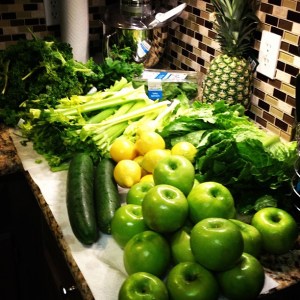
Fruits and Veggies Pre-JuiceI had looked into buying all the juice for my cleanse from a couple of local companies like JuiceLand and Skinny Limits, but when prices were coming up at $175-200 for an organic cleanse, I looked into the DIY option. I found some recipes online here and here that imitated the well-known BluePrint cleanse, borrowed a Jack LaLanne Pro juicer from a friend and then went shopping. I only spent $68.61 on organic fruits and veggies.  So worth it.  Now, the juicing took about 3 hours total, but considering I usually spend about an hour and a half each day preparing breakfast, lunch and dinner, that’s really not any different.  It was super nice to come home from work and have my “meal” already made and let my husband fend for himself.   I started with all these fresh vibrant fruits and veggies, which was more produce than I usually buy in a whole week.
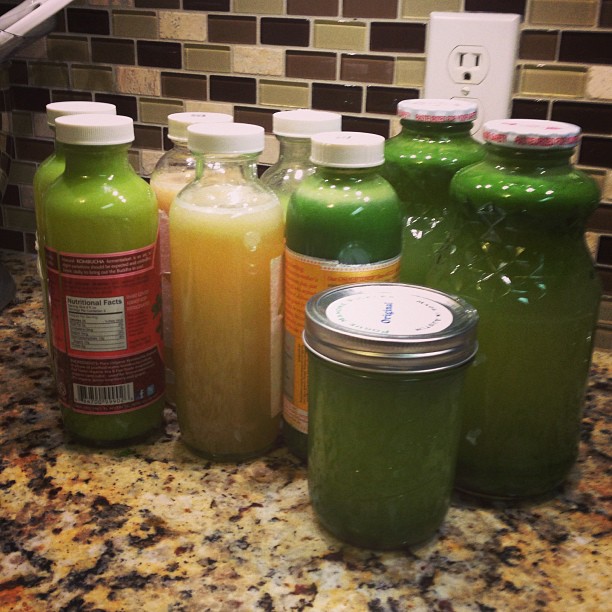
At the end, I had a little over 2 days worth of juice:

  1. Breakfast: Green Juice – Kale, Spinach, Romaine, Parsley, Apple, Cucumber, Lemon and Celery
  2. Morning Snack: Pineapple-Apple-Mint Juice
  3. Lunch: Green Juice
  4. Afternoon Snack: Agave-sweetened Lemonade with Cayenne Pepper
  5. Dinner: Green Juice
  6. Evening Snack: Cashew-Vanilla-Cinnamon Milk (which is blended, not juiced)

Juice

Biggest surprise?  How much I liked the juices. The green juice was delicious… a little celery-y, but super yummy. The cashew milk that everyone seems to love was the most disgusting thing ever. I only had it the first night and barely kept it down. I had more green juice the second night.

Biggest regret? Not starting an awesome compost pile with all the fruit and veggie pulp that the juicer collected.  Guess I’ll have to do it again!

Was it awful? Overall, I was really hungry the whole time, which is normal, but tough. Watching tv was hard and commercials made me crave donuts and pizza. They say that since your body is being detoxed, you could feel terrible… I really didn’t. In fact, I had more energy than ever. During the fast, I was kind of wondering if it was worth it and it wasn’t until afterwards that I realized it was.  I totally lost my desire for junk food and coffee and alcohol, and felt sick whenever I had those things, which definitely helped my self-control.  I also lost 4 pounds which I have easily kept off since.

Ultimately, I would recommend the experience to anyone, especially those suffering from sickness or trying to break bad food habits. I will absolutely be purchasing a juicer and making juice part of my normal routine so that I get more nutrients into my diet in a delicious way.  But, if I ever do a cleanse again, I’ll want a buddy… it was hard to do it alone!

So, what do you think? Would you ever try a juice cleanse?

…And What To Do About It

Yesterday, I shared part 1 of my review on Gary Taubes’  book, Why We Get Fat: And What to Do About It. His arguments really hit home with me, and I’m sure did with a few of you as well.  So, naturally, the next step after realizing why we are getting fat is figuring out what to do about it.  “Not all of us get fat when we eat carbohydrates, but for those of us who do get fat, the carbohydrates are to blame; the fewer carbohydrates we eat, the leaner we will be.”  It’s frustratingly beyond our control if we are predisposed to get fat, but at least there’s a solution.

Not all carbs are the same…  Leafy green veggies have lots of fiber that take a while to digest and therefore the carbs don’t cause blood sugar levels to spike.  But, cheap carbs, like bread, pasta, potatoes, rice, beer, soda, and all processed foods, have highly concentrated amounts of carbohydrates and are easy to digest. That means the glucose quickly enters our bloodstream, causing blood sugar to spike and with that insulin levels to go up.  Fruit, while not as carb-concentrated, is easy to digest and therefore might have a fattening effect on the most insulin resistant people.  The worst effect comes from a diet filled with fructose and highly sweetened food items. Our livers are not designed to handle the sugar overload and respond by turning it directly into fat. So when fructose is consumed with glucose (all those yummy processed foods/cheap carbs), insulin levels rise and start storing all that fat away instantly. It hastens the effect of carbs.  This explains why some carb-heavy cultural diets, like in Asian countries where rice is a staple, don’t have a fattening effect: because they also eat traditionally very little, if any, sugar and have otherwise healthy, lean diets of fish and veggies.

We’re addicts.  The more insulin resistant we become, the more insulin that’s constantly flowing through our bloodstream, craving a quick fix of glucose for fuel; that’s why we constantly crave those carbs even when we try to eat healthy and feel truly full on meat and veggies.  The solution is as radical as breaking an addiction: eliminating those cheap carbs completely to break the habit.  This is why many on the paleo diet are so successful in losing weight over many vegetarians/vegans, who often supplement their plant-based diet with carbohydrates.  Paleos are eating the way our ancestors did as hunter-gatherers – high protein & fat from meat and lots of wild plant foods that are low in carbs and low on the glycemic index.  Ultimately, Taubes suggests consuming fewer than 20 grams of carbohydrates per day and eliminating sugar completely to correct your weight. Beyond the benefits of losing weight, you will also find that your body starts healing itself naturally (the way God designed it to), since sugar actually suppresses your immune system for hours every time you consume it. Order his book here to learn more!

If all of this text has been a little overwhelming for you visual people, here is an awesome infographic that explains most of what I’ve summarized from his book.  Enjoy!

Carbs Are Killing You

[Source: Carbs Are Killing You]

So what do you think of Taubes’ argument?  Will you read his book? Will you go carb & sugar free?