Why We Get Fat…

“We get fat, our physicians tell us, because we eat too much and/or move too little, and so the cure is to do the opposite.” – Michael Pollan, In Defense of Food

When my husband and I are planning a date night out to a really great restaurant and want to eat as much delicious food as possible, we often eat a light lunch or do something active to make ourselves hungrier for the big meal. But wait, that’s also what I’m told to do to lose weight…. Something’s wrong with this reasoning.

In his book, Why We Get Fat: And What to Do About It, Gary Taubes tackles this cultural mindset of “calories in, calories out,” turning it on it’s head and calling into question a principle we’ve always held to be true. It’s a fascinating read, with lots of really compelling cultural case studies and the scientific details in layman’s terms that help you to understand his argument.   I have a bad habit of reading the Appendix of a book first and will admit that I was disappointed with some of the diet recommendations he makes – in particular, okaying alternative sweeteners like Splenda and Nutrasweet and diet soda; but, I had a long plane flight ahead of me and nothing else to read so I kept on.  I’m glad I endured because there are definitely some great nuggets of information I got from this book:
 Obesity has become an epidemic.  1 in every 3 Americans are considered obese compared to only 1 in 9 fifty years ago. I’ll admit that I used to think that most people get fat by simply being lazy and/or eating too much junk food.  But, a case study of many areas of poverty shows that there are many who are malnourished (less calories in), work manual labor (more calories out), and who are still obese or overweight.  And in research studies, hormone-manipulated rats proved that they immediately began to overeat, become sedentary and quickly grew obese; even when completely deprived of food, forced to diet or forced to exercise, the rats retained their fat while their organs deteriorated.  There must be some other determining factor than being slothful and gluttonous…. it seems more to do with genes and hormones than simply overeating.  The answer lies within the fundamental definition of obesity- “a disorder of excess fat accumulation.”

Taubes relates fat tissue to a wallet: “you’re always putting fat into it and always taking fat out.”  But only certain forms of fat can go in and out, while others go in and stay. When fatty acids enter a fat cell, they join up with a glycerol molecule and two other fatty acids to become a triglyceride. Triglycerides are too big to go back out of the cell membrane, so they stay captive until they can be disassembled.  The hormone that works to create triglycerides is insulin.  Insulin works through the LPL enzyme and the HSL enzyme.  The LPL enzyme sends fatty acids into the cells for energy. When we exercise, LPLs trigger the release of fat from fat tissue and send those into muscle cells to burn off.  (As soon as we stop, though, LPLs work to help fat cells regain that fatty fuel, which is why Taubes claims exercise doesn’t make us lose fat, just gains us muscle.) The rest of the time, insulin triggers LPLs to send fatty acids into fat cells and tells muscle cells to burn blood sugar rather than fatty acids, so insulin basically keeps these fatty acids in your fat cells.  Insulin also suppresses the HSL enzyme, which is the enzyme that breaks down the triglycerides into fatty acids to move out of the fat cells.  And when our fat cells get full, insulin creates new ones… working constantly to make us fatter… it’s no wonder that so many diabetics that start insulin therapy gain so much weight.  Further, every other hormone in our body works to release fat from our fat tissues so that it can provide fuel for what it needs to do, but “insulin trumps the effects of other hormones.”  And as we get fatter, our demand for more fuel increases, which causes our appetite (especially for carbs) to increase. So, to lose fat, we must lower our insulin levels.  The way to do that is to diminish the cause for insulin secretion – carbohydrates.

Okay, but I eat healthy and I still struggle to lose weight, while I watch others eat fast food daily and stay super slim… frustrating, isn’t it? One reason is that “some people will secrete more insulin than others, and those who do are likely to put on more fat and have less energy.”  The other reason is that many of us have become insulin resistant. Eventually, your cells stop wanting all the glucose you’re putting in your body, and they start making insulin’s job harder to get it out of the bloodstream, which results in you secreting even more of it.  Everyone’s tissues react differently: if your muscle tissue is really sensitive to insulin, then you’ll use up more glucose in those cells, making you naturally lean, but if your fat cells are more sensitive, then glucose will go there instead and you’ll become overweight. And as we age, our muscles naturally become more resistant to insulin, which explains why we tend to get fatter as we get older.  Most importantly, this doesn’t just affect us, but our children too.. “the higher the level of a mother’s blood sugar, the more glucose her child gets in her womb” and therefore will be born with more fat and predisposition to be insulin resistant.

At this point in the book, he had my attention… is this resounding with you as well?  Tune in tomorrow for And What To Do About It.

A GMO News Update

A couple of months ago, I posted a blog all about the terrifying dangers of GMOs – a topic that many people don’t know much about and one that was completely unknown to me until just a couple of years ago. Finally, the truth is starting to come out and I thought I would share a few updates with you in case you missed it:

In March, President Obama signed an agricultural bill into law that contained a secret, well-hidden (to the public, not to the government) rider with very bad news for us.   Monsanto (the corporation behind GMOs) wrote this rider themselves to legally protect them from ever being held responsible for the consequences of the products they create.  It’s called the Farmer Assurance Provision, meaning that companies can research, produce and sell genetically modified seeds and crops without interference or consequences from the government, even if health issues result from those products.  This rider came shortly after federal courts had ruled that the US Dept of Agriculture had not fully evaluated the physical harm that could result from GMOs.  While the language in the bill seems to lead on that regulations are already in place to prevent such issues, this is not true.  The FDA asks Monsanto to provide its own studies to prove that their products are safe.  For a company that’s making billions off these items, I doubt moral obligation would result in any self-imposed regulations.  This is clear failure of the government to protect its people from the power of large corporations.  Thankfully, when the truth came out, outrage by the people towards what has now been dubbed the “Monsanto Protection Act” is forcing Congress to review the bill. Finally, some Senators are stepping up to speak out and try to get this repealed.  Fingers crossed!

In the meantime, there are a couple of easy ways that you can take action and protect yourself against the harms of GMOs:

  • Take a stand and tell your Senator to fight for your rights at Food Democracy Now
  • Download the awesome FREE new Buycott app to help you shop GMO-free.  Simply scan the barcode of an item while you are shopping to see if the company uses GMOs in its products.  It also lets you support companies who support other causes you care about!  Learn more here.

What do you think about this recent legislation? Is this news to you?

– Christine

Resources:

http://www.policymic.com/articles/31783/monsanto-protection-act-highlights-special-interests-behind-legislative-process

http://en.wikipedia.org/wiki/Farmer_Assurance_Provision

http://geneticroulettemovie.com/

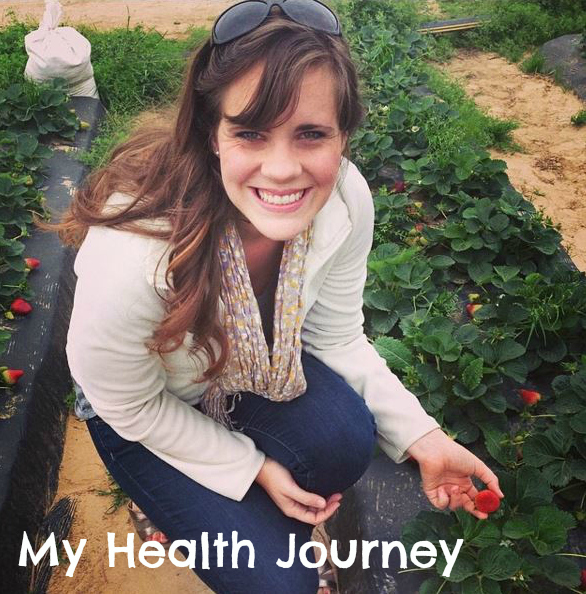
My Health Journey

Strawberry PickingI’ve been battling intense allergies for the past two weeks, so I’m sorry it’s been so long since my last post.  I have to admit that I became a bit discouraged, starting to believe that this new healthy lifestyle wasn’t helping at all.  But I realized that I need to reflect a little and remember how far I really have come with my health. Since I haven’t shared my story with you yet, I thought this would be the perfect time…

For as long as I can remember, I have been sick or in pain most of the time.  While it’s never been anything super serious, I’ve definitely had a few debilitating days.  For the most part, it’s simply just kept me from enjoying life to the fullest.  Throughout my childhood, I got sick pretty often, mainly suffering from respiratory illnesses, and I’ve always had nearly constant back pain.  I moved to Austin at age 6 and developed allergies and asthma, often developing into a sinus infection, pneumonia, bronchitis, you name it, and then of course, taking lots of medicine. I always complained of back pain as a kid and my parents did everything they could to discover the cause: taking me to multiple doctors & specialists, having MRIs & xrays and doing physical therapy.  No one could figure it out. When I reached middle & high school, participation in sports only made it worse, and I started to have shoulder pain as well.  Doctors prescribed muscle relaxers, Advil or physical therapy to manage the pain.  Then, with the onset of puberty came acne (and other hormonal problems).  My dermatologist prescribed an antibiotic for the acne, which I proceeded to take for only the next 8 years.

In college, everything got even worse.  I was sick with bronchitis for the entire second semester of my Freshman year.  Then, winter of Sophomore year brought even more illness.  It started with my typical holiday seasonal allergies, developing into an apparent sinus infection compounded with bronchitis.  Over the course of a month and a half, I was prescribed 6 courses of antibiotics and 3 steroid packs.  Since I had a fever every day, the doctors also suggested Advil every 4-6 hours… for a whole month.  My back pain became so intense that one doctor even said I “probably” had ovarian cancer… I didn’t.  I saw 10 different doctors, trying to figure out what was actually wrong.  No one could diagnose me.  By March, my stomach became so inflamed from all those medications that I couldn’t keep any food down or sleep.  It eventually culminated in a trip to the ER and a week-long stay in the hospital for gastritis.

I was furious, depressed and hopeless…  I still didn’t have any answers and doctors were making me worse, not better.  This was my turning point.  As a last straw, I made an appointment to visit an “alternative doctor,” who immediately put me on probiotics to rebuild my immune system and my gut.  She gave me some vitamins and changed my diet from the bland, carb-heavy “sick diet” to lots of protein and vegetables.  Within a week, I was a different person, and continued to get better and better.  That experience made me realize that there had to be something to this alternative, holistic medicine thing.

Since that time, I’ve been healthier – staying away from fast food, eating more veggies and taking vitamins.  But, I still felt like my immune system just wasn’t performing up to par… it takes me awhile to get over being sick, I’ve suffered from hormonal issues (girls, you know) and I struggled with back pain daily.   After watching a couple of great documentaries and reading some surprising health articles, I realized that even this was not normal and that I didn’t have to live this way.  Providing even more motivation, after getting married a year ago, I inevitably began to think about my future children.  I certainly didn’t want my kids to be sick all the time, and, I was frightened by the epidemics of food allergies and autism in kids today, not to even mention the possible (again, epidemic) fertility problems I could face trying to get pregnant someday.  If you know me, you know I don’t accept “well, that’s just how things are” very easily.  I was going to find answers.

Now, I read books, watch lots of documentaries, and keep up with new research and articles.  I learn something new every day that I can put into practice immediately.  Now, my healing comes from food that I can buy from a local farmer, not from medication – it’s much more delicious and there’s no long list of terrible side effects! I know that it may take my body a while to recover from all the toxins I put in it for so many years, but I have complete confidence that it will rebuild itself.  God designed our bodies to heal themselves given the right nutrients. I’ve already seen a huge difference – pain and sickness are now in the minority in my life and I’m feeling better every day.  Plus, I’m giving my future children a real chance to be healthy, and that will be the most rewarding result of all.

A Birthday Treat

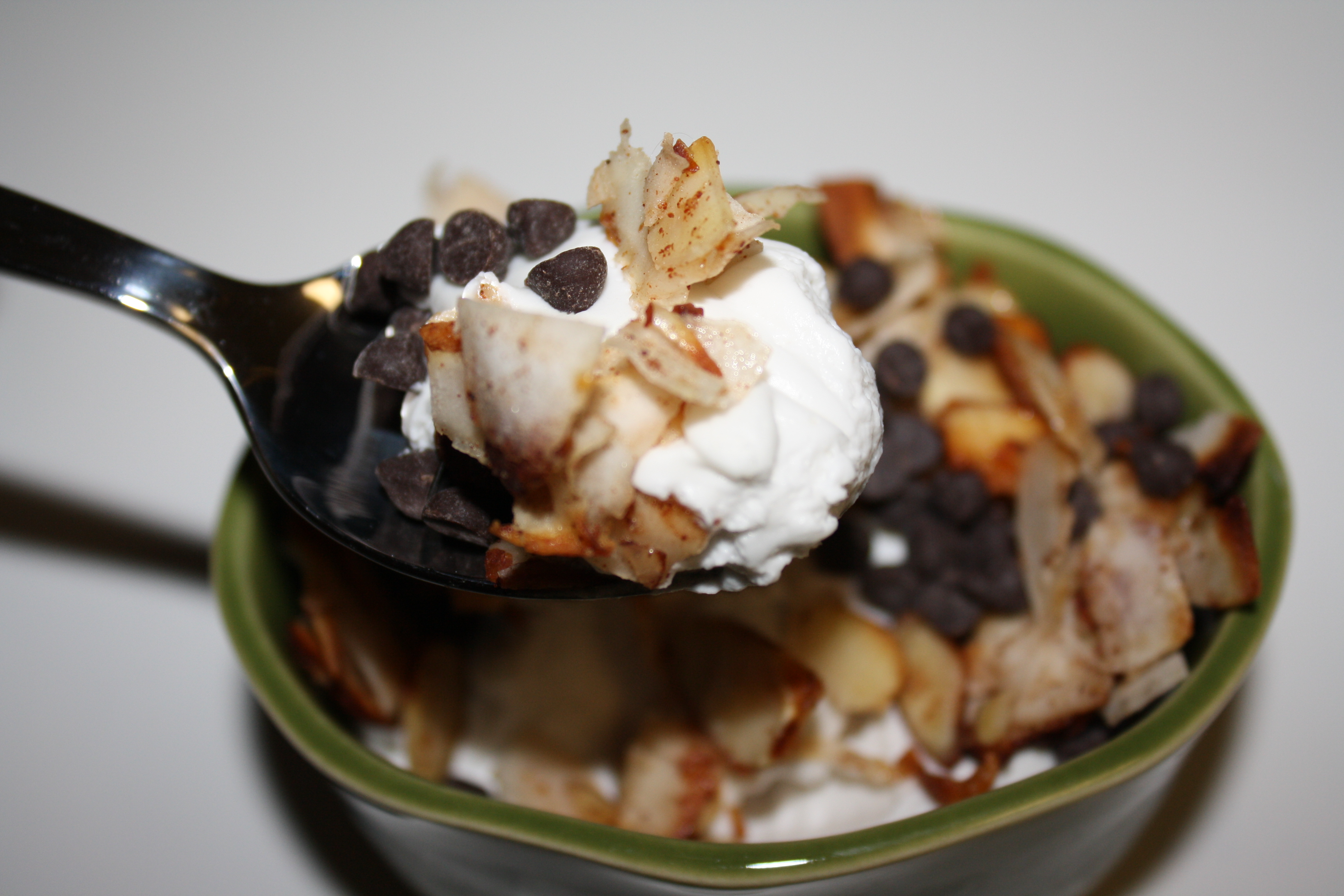
Coconut-Honey Mousse with Toasted Coconut, Almonds & Dark Chocolate Chips

I can’t resist celebrating my birthday with a little something sweet. Here’s a recipe that won’t destroy your health, but sure doesn’t taste healthy.

Whipped Coconut & Honey Mousse

Ingredients:

  • 1 can full fat (this is the good kind of fat) organic coconut milk
  • 2 tablespoons local honey
  • 1 teaspoon organic vanilla extract
  • Optional toppings: dark chocolate chips, roasted coconut flakes & sliced almonds

Open the can of coconut milk and put in the fridge overnight uncovered. You’ll find that the top 3/4 of the can has hardened enough where you can scoop out the coconut milk. Scoop out the hardened part (its okay if you get some of the liquid at the bottom) into a mixing bowl. Add the honey and vanilla extract and then whip with beaters or your whisk attachment until it has the consistency of whipped cream. Then separate into a few ramekins – I usually get 5-6 servings out of a full can. I toss some coconut flakes and sliced almonds in some melted coconut oil, a dash of cinnamon and a little honey before putting on a cookie sheet to toast in the oven for a few minutes. And/or you can add a few dark chocolate chips – I found some without any soy at Natural Grocers!

And now time to devour the deliciousness by the spoonful…. Enjoy!

Spoonful of Goodness

A Whole Chicken for Your Nest Egg: Bone Broth

Crockpot Bone Broth

We typically think of cooking an animal only for its meat, but we’re missing some of the best part!  French culinary masters consider stock/bone-broth to be a kitchen essential in flavoring soups, rice, sauce, gravy, and much more. Our ancestors survived on hearty broth made from bones, especially during the winter when fresh food was hard to come by – our bodies have gotten used to the nutrients that animal bones provide and depend on them to grow, repair and function.  This is just one of the many reasons I’m not a vegan.

Animal bones (and the marrow) contain a protein molecule called glucosamine.  Glucosamine, the main ingredient in arthritis meds and joint supplements, helps build and repair joints and also triggers the growth of new collagen. Collagen provides structural support for our bones, tendons and ligaments, and gives our skin shape, texture and youthfulness. While collagen injections may make the Real Housewives’ lips temporarily plump, consistent regeneration of the collagen in your skin, hair, bones, arteries and more can only come from making it part of your diet. I don’t know about you, but as I age, I want to look and feel young… here’s to a retirement full of active travel and less wrinkles! The good news is that natural collagen and glucosamine are an easy and tasty addition to your diet, and will not only help prevent issues, but also rebuild and repair. By simply simmering the nutrients out of the bones, joints and cartilage slowly, you are able to safely extract the minerals and vitamins (magnesium, vitamin D & calcium), as opposed to the high-heat damaging methods used in making glucosamine pills.

So here’s how I make my weekly bone broth: After I cook my whole chicken, I put the bones back in my crockpot, along with 8 cups of filtered water. I roughly chop any mix of the following to add to the pot: onion, celery, beet greens, carrots, garlic, leek or fresh herbs. You can also add a couple tablespoons of white wine or apple cider vinegar, as the acid in those liquids helps get more minerals from the bones.

Bones + Veggies in Crockpot

Simmer on low for around 4 hours.

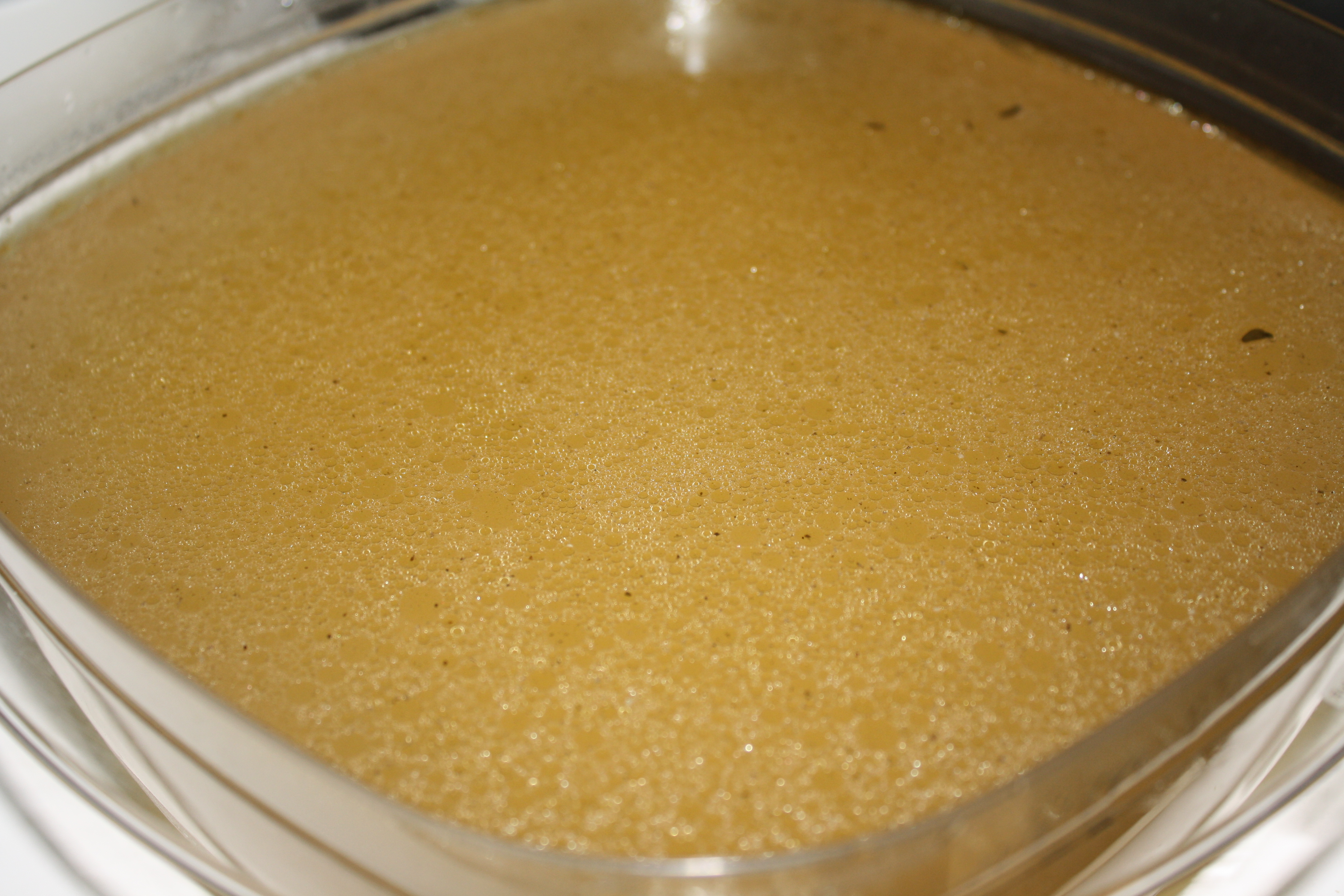
Broth after 4 hours of simmering in crockpot

Then strain and transfer to a BPA-free container.  Use within a couple of days from the fridge, or store in the freezer.

Broth

You can use it in any recipe that calls for chicken broth, as a soup or gravy base, to replace water when making rice delicious or drink by itself. And of course, you can do the same with beef bones or fish bones for different broth flavors.  Considering how expensive a container of broth costs, this is a great deal – plus, no chemical preservatives or flavor additives!

A special tip for dog owner’s: I sometimes add a little broth to my puppy’s food to help her joints and she loves it! But, be sure not to use any onion in that batch as it is toxic to dogs).

Sources: Wikipedia searches of collagen & glucosamine and, of course, Deep Nutrition.